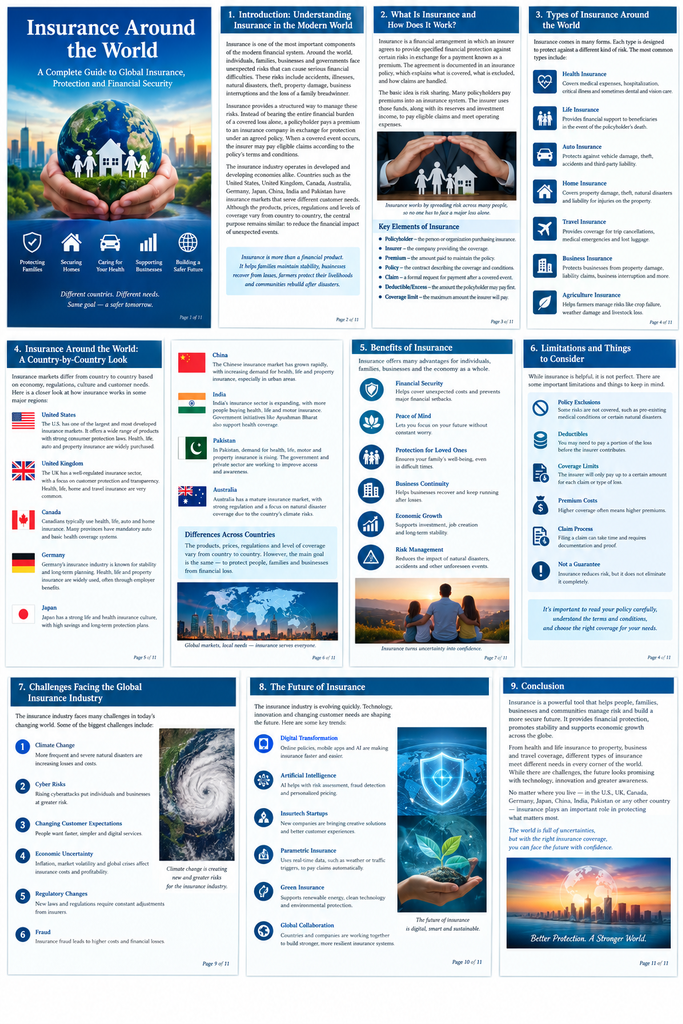
Insurance Around the World: A Complete and Detailed Guide to Global Insurance, Financial Protection, and Future Trends

Image 1: Insurance helps individuals, families, and businesses prepare for unexpected financial risks around the world.
1. Introduction to Insurance Around the World
Insurance is one of the most important parts of the modern financial system. Every day, individuals, families, businesses, and governments face risks that can create significant financial difficulties. These risks include accidents, serious illnesses, property damage, natural disasters, theft, business interruptions, cyberattacks, and the unexpected loss of a family member.
An unexpected event can happen at any time. A family may face expensive medical treatment, a homeowner may lose property in a fire, a driver may be involved in a road accident, or a business may suffer financial losses after a natural disaster. Without adequate financial protection, these events can consume savings, create debt, and disrupt people’s lives.
Insurance provides a structured method of managing many of these risks. Policyholders pay an agreed amount, known as a premium, to an insurance provider. In return, the provider agrees to pay eligible claims when specified events occur, subject to the policy’s conditions, exclusions, and coverage limits.
Today, insurance is an international industry serving millions of households and businesses. Countries such as the United States, the United Kingdom, Canada, Germany, Australia, China, India, Japan, and Pakistan have different insurance systems designed to meet local needs.
Some countries depend heavily on private insurance companies, while others combine public social protection programs with private coverage. The availability of insurance, its affordability, and the level of protection offered can vary considerably between countries and even between regions within the same country.
Insurance is not simply a way to compensate people after a loss. It also supports economic stability, business investment, international trade, homeownership, healthcare financing, and disaster recovery.
As the world becomes more interconnected, new challenges are emerging. Climate change, inflation, cybercrime, technological developments, and changing population needs are transforming the way insurance companies assess risk and serve their customers.
This comprehensive guide explains how insurance works, explores its major types, examines insurance systems around the world, discusses the benefits and limitations of coverage, and considers the future of the global insurance industry.
2. What Is Insurance? Understanding the Basic Concept

Image 2: Understanding insurance terms is an important first step toward choosing appropriate financial protection.
Insurance is a contractual arrangement in which an insurance company agrees to provide specified financial protection against certain risks in exchange for premiums.
The basic principle is called risk pooling. Many policyholders contribute premiums to a common financial system. The insurer uses the pooled resources, along with its reserves and investment income, to pay valid claims and meet its expenses.
Consider an example involving 10,000 homeowners who purchase suitable property insurance. Each homeowner pays a premium according to the terms of their policy and the risks involved. If a number of homes experience covered damage, the insurer uses its available resources to pay eligible claims.
Most policyholders will not experience every insured event during the same period. Pooling risk allows the financial consequences of covered losses to be distributed across a larger group rather than being borne entirely by the affected individuals.
However, insurance companies must calculate premiums carefully. If premiums are insufficient to cover claims, expenses, and other obligations, an insurer may experience financial difficulties. This is why underwriting, actuarial analysis, reserves, and regulation are important parts of the insurance industry.
Important Terms Used in Insurance
Insurance policy: A legal contract that describes the protection provided and the conditions that apply.
Policyholder: The individual or organization that purchases or holds an insurance policy.
Insurer: The company or organization that provides the insurance coverage.
Premium: The payment required to purchase or maintain insurance.
Claim: A request for payment or benefits following an event that may be covered by the policy.
Deductible or excess: The amount the policyholder must generally contribute toward a covered loss before the insurer pays the remaining eligible amount.
Coverage limit: The maximum amount the insurer will pay for a particular covered loss or category of benefits.
Beneficiary: A person or entity designated to receive a benefit under certain policies, particularly life insurance.
Exclusion: A circumstance, event, expense, or type of loss that the policy does not cover.
Underwriting: The process insurers use to assess risk and determine whether to provide coverage and on what terms.
Why Is Insurance Necessary?
Insurance can be valuable because unexpected losses are often difficult to predict and may be expensive to manage.
A person may be able to save gradually for routine expenses but may not have enough money available to rebuild a home after a major fire or pay for a substantial liability claim.
Insurance can help transfer or share certain financial risks. It allows people and organizations to plan their finances with a clearer understanding of how some unexpected events may be handled.
Nevertheless, insurance does not eliminate all risks. A policyholder must still understand the contract, maintain appropriate coverage, pay premiums when due, and comply with the policy’s requirements.
3. History and Evolution of the Global Insurance Industry

Image 3: Maritime trade played an important role in the development of organized insurance.
Insurance has a long history that reflects humanity’s efforts to manage uncertainty and protect valuable resources.
3.1 Early Forms of Risk Sharing
In ancient societies, merchants transported goods over long distances by land and sea. Their journeys involved considerable danger. Ships could sink, cargo could be stolen, and trading caravans could suffer losses because of accidents, conflict, or severe weather.
Merchants developed arrangements that distributed some of these risks among multiple participants. Communities also established systems of mutual assistance to support people affected by death, illness, or other hardships.
Although these arrangements were different from modern insurance contracts, they introduced the important idea that financial losses could be shared instead of being carried by one person alone.
3.2 The Development of Marine Insurance
Marine insurance became increasingly important as international trade expanded. Traders needed protection for ships, cargo, and commercial investments exposed to the dangers of ocean travel.
London developed into a major center for maritime insurance. The market associated with Lloyd’s grew from a coffee house frequented by merchants and shipowners into an international specialist insurance and reinsurance marketplace.
Marine insurance helped businesses manage the financial consequences of shipping losses. It also contributed to modern underwriting practices, where specialists evaluate risks and determine the terms under which insurance can be provided.
3.3 The Growth of Life Insurance
Life insurance developed to help families manage the financial consequences of death.
When a person provides the main income for a household, their death may leave dependents facing rent, mortgage payments, education expenses, and other financial obligations. Life insurance can provide a financial benefit to designated beneficiaries when a covered death occurs.
Over time, life insurance products became more diverse. Some focused on protection for a specific period, while others offered lifelong protection or savings-related features.
3.4 Fire and Property Insurance
As cities expanded, fires sometimes destroyed large numbers of homes and businesses. These disasters created demand for insurance that could help property owners recover from covered damage.
Property insurance gradually expanded to include protection against various risks, depending on the product and market. Modern policies may cover buildings, business equipment, inventory, and personal possessions.
Today, property insurance is important for homeowners, landlords, commercial property owners, manufacturers, and other organizations.
3.5 Insurance During the Industrial Revolution
Industrialization created new financial risks. Factories, railways, heavy machinery, and growing urban populations increased exposure to accidents, workplace injuries, property damage, and transportation losses.
Businesses began using more specialized insurance products. Governments also developed regulatory frameworks to oversee insurance companies and protect policyholders.
Social insurance systems expanded in various countries, helping provide financial support for risks such as old age, unemployment, disability, and workplace injuries.
3.6 Modern Insurance and Digital Transformation
During the twentieth and twenty-first centuries, insurance developed into a sophisticated global industry. Products expanded to cover health, travel, vehicles, agriculture, professional liability, cyber risks, and many other exposures.
Digital technology has transformed the way insurance is purchased and managed. Customers can compare quotations online, submit documents electronically, and track claims through digital services.
Insurers now use advanced analytics, satellite data, connected devices, and artificial intelligence to support risk assessment and claims processing.
The industry continues to evolve as economic conditions, customer expectations, environmental hazards, and emerging technologies change.
4. Major Types of Insurance Available Worldwide

Image 4: Different insurance policies protect against different categories of financial risk.
Insurance is divided into several major categories. Each category addresses particular risks, and the protection offered depends on the policy wording and the legal framework of the country where the policy is issued.
4.1 Life Insurance
Life insurance provides a financial benefit to designated beneficiaries if the insured person dies under circumstances covered by the policy.
For families, this protection can be particularly important when one or more household members depend on the insured person’s income.
The benefit may help pay outstanding debts, everyday living expenses, education costs, or other financial commitments. Some policies also include additional benefits or savings-related features.
Term life insurance provides coverage for a specified period, such as 10, 20, or 30 years. It is commonly used to protect dependents during working years or while a mortgage is outstanding.
Whole life insurance generally provides lifelong coverage if the policy’s requirements are maintained. Some policies accumulate cash value according to their contractual terms.
Universal life insurance combines life protection with a cash value component and may provide flexibility in premiums or benefits, subject to policy provisions, charges, and other conditions.
Group life insurance is often offered through an employer or organization. Coverage may depend on employment status, membership, and the group’s policy terms.
When selecting life insurance, people should consider the number of dependents, outstanding debts, future financial responsibilities, existing savings, affordability, and the duration of protection required.
4.2 Health Insurance

Image 5: Health insurance can reduce eligible medical expenses and help patients access covered healthcare services.
Health insurance helps individuals and families manage expenses associated with medical treatment. Depending on the plan and healthcare system, coverage may include hospital stays, consultations, surgery, diagnostic tests, prescription medicines, maternity services, and rehabilitation.
Medical treatment can be expensive, especially when patients require emergency care, surgery, or long-term treatment. Health insurance may reduce the amount that a patient must pay personally for covered services.
Health insurance arrangements vary across the world. Some countries rely primarily on publicly funded healthcare systems, while others combine public programs with employer-sponsored and individually purchased private insurance.
In the United States, people may obtain coverage through employers, government programs, or individual plans. In countries with universal healthcare systems, public coverage provides a foundation for eligible services, while private insurance may offer additional benefits.
Common health insurance terms include premiums, deductibles, copayments, coinsurance, provider networks, and annual limits.
Before purchasing a policy, customers should check:
- Which medical services are covered.
- Whether specific hospitals and doctors are included.
- How prescription medicines are handled.
- Whether waiting periods or exclusions apply.
- What happens during medical emergencies abroad.
- How pre-existing conditions are treated under applicable rules.
- Whether prior authorization is required for certain treatments.
Health insurance does not necessarily cover every medical expense. Customers should understand the policy’s benefits and limitations before relying on it.
4.3 Motor and Car Insurance
Motor insurance provides financial protection against specified losses involving cars, motorcycles, trucks, and other vehicles.
Road accidents can result in vehicle damage, medical expenses, injuries, property damage, and legal liabilities. Motor insurance can help manage certain costs arising from these events.
Third-party liability insurance covers specified legal liabilities for injuries or property damage caused to other people. This type of coverage is compulsory in many jurisdictions.
Collision coverage generally helps pay for covered damage to the insured vehicle caused by a collision, subject to the policy terms and deductible.
Comprehensive vehicle coverage may cover specified losses such as theft, fire, vandalism, and certain weather-related damage. The exact meaning of comprehensive coverage differs across markets.
Some policies also offer roadside assistance, rental vehicle benefits, or personal accident coverage.
Motor insurance premiums may depend on driving history, location, vehicle type, annual mileage, selected limits, deductibles, and other factors permitted by local law.
Drivers should compare coverage limits, exclusions, repair arrangements, claim procedures, and the financial strength of the insurer rather than selecting a policy based only on price.
4.4 Home and Property Insurance

Image 6: Home insurance can help protect a major household investment against specified property losses.
Property insurance helps protect buildings, personal belongings, and commercial assets against covered damage or loss.
For homeowners, a suitable policy may cover the structure, certain personal possessions, personal liability, and additional living expenses after an insured event makes the home temporarily uninhabitable.
Renters may purchase contents insurance to protect their possessions and obtain certain liability benefits even though they do not own the building.
Commercial property insurance can cover eligible business premises, equipment, stock, furniture, and other insured assets.
Potential covered risks include fire, theft, vandalism, and certain storms. However, earthquakes, floods, groundwater intrusion, and other hazards may require separate coverage or may be excluded.
Property owners should calculate realistic rebuilding costs, review the value of their possessions, understand deductibles, and check whether their location is exposed to specific natural disasters.
4.5 Travel Insurance
Travel insurance helps protect travelers against certain unexpected expenses before or during a trip.
Travel disruptions may arise from illness, injury, severe weather, flight cancellations, lost baggage, or other unforeseen circumstances.
Depending on the policy, travel insurance may cover eligible trip cancellation costs, emergency medical treatment abroad, medical evacuation, travel delays, baggage loss, or other specified events.
Travelers should pay particular attention to medical coverage when visiting countries where healthcare costs are high or where their existing health insurance offers limited international protection.
Policies may exclude known events, certain high-risk activities, specific destinations, or some pre-existing medical conditions. Travelers should check documentation requirements and the process for reporting a claim.
4.6 Business Insurance
Business insurance helps organizations manage financial risks associated with property damage, employee injuries, legal liability, professional errors, and interruptions to operations.
A small shop may need protection for its stock, equipment, premises, and customer-related liabilities. A technology company may need professional liability and cyber coverage. A manufacturer may require property, machinery, product liability, and transportation insurance.
Important categories include:
- Commercial property insurance: Protects specified business assets against covered losses.
- General liability insurance: Covers certain third-party injury, property damage, and related legal claims.
- Professional indemnity insurance: May cover eligible claims involving alleged errors, negligence, or failures in professional services.
- Workers’ compensation insurance: Provides specified benefits for workplace injuries or illnesses under applicable laws.
- Business interruption insurance: May cover eligible income losses and certain ongoing expenses following a covered disruption.
- Cyber insurance: May assist with specified expenses and liabilities associated with cyber incidents.
The appropriate combination depends on the business’s industry, size, location, operations, contractual obligations, and financial resources.
4.7 Agricultural and Crop Insurance
Agriculture is vulnerable to drought, floods, storms, pests, livestock diseases, and other threats that can reduce farmers’ income.
Crop insurance may compensate eligible farmers for specified losses according to the policy or program. Livestock insurance may cover certain animal deaths or other defined events.
Some agricultural products use weather measurements or other objective indicators to determine payouts. Others assess actual damage or yield losses.
Agricultural insurance can support rural livelihoods and food production, particularly when farmers have limited savings. However, policies must be affordable and designed around local growing conditions, reliable data, and the risks farmers actually face.
4.8 Disability and Income Protection Insurance
Disability or income protection insurance may replace part of a person’s earnings if illness or injury prevents them from working under the policy’s conditions.
This coverage can be important for workers whose households depend heavily on their regular income.
Policies differ in waiting periods, benefit amounts, maximum payment periods, definitions of disability, and exclusions. Some cover short-term absences, while others are designed for longer periods.
Customers should examine how the policy defines the inability to work and whether benefits are affected by other income sources.
4.9 Liability Insurance
Liability insurance helps protect individuals and businesses against certain legal responsibilities for injury, property damage, or other covered claims.
For example, a customer might be injured at a business premises, or a professional service provider might face a claim alleging an error in their work.
The policy may cover eligible legal defense expenses, settlements, or judgments, subject to its wording and limits.
Liability insurance is especially important for businesses that interact with customers, manage property, provide professional services, manufacture products, or operate vehicles.
4.10 Marine and Aviation Insurance
Marine insurance protects eligible interests associated with ships, cargo, and transportation by water. It is important for importers, exporters, shipping companies, and logistics providers.
Aviation insurance addresses risks involving aircraft, operators, passengers, and certain aviation-related liabilities.
International transportation can expose businesses to substantial losses. These specialist insurance products help manage specified risks associated with global trade and travel.
5. How Insurance Works: From Purchasing a Policy to Receiving a Claim

Image 7: Insurance involves risk assessment, premium payments, policy administration, and claims management.
The insurance process usually begins when a customer identifies a risk and seeks appropriate coverage.
First, the customer provides relevant information about the risk. An insurer evaluates the information and decides whether to offer coverage, what terms to apply, and how much premium to charge.
If the customer accepts the terms and completes the required steps, the policy is issued. The policyholder must then comply with the payment schedule and other contractual requirements.
If an event occurs that may be covered, the policyholder reports it to the insurer and submits a claim.
A Practical Example
Imagine that a business purchases property insurance for its shop. The policy covers specified fire damage up to a limit of $100,000, with a deductible of $1,000.
A covered fire causes $20,000 in eligible damage. Assuming the deductible applies to the entire loss and no other conditions affect the claim, the insurer would pay $19,000, while the business would bear the $1,000 deductible.
If the eligible loss were greater than the policy limit, the business might have to pay the amount above the limit as well.
This example illustrates why customers must understand coverage limits, deductibles, and the rules that apply to claims.
The Main Stages of a Claim
- Report the incident. Notify the insurer within the required timeframe.
- Provide documentation. Submit forms, receipts, photographs, medical records, or other relevant evidence.
- Assessment and investigation. The insurer determines whether the event is covered and evaluates the amount of the loss.
- Claim decision. The insurer approves, partially approves, or rejects the claim, explaining the decision according to applicable requirements.
- Payment or dispute resolution. Approved benefits are paid under the policy, while disputed decisions may be challenged through the available complaint process.
Claims procedures differ between insurance types and countries. Policyholders should retain documents and provide truthful information throughout the process.
6. Insurance Markets Around the World

Image 8: Global insurance markets reflect different economies, regulations, healthcare systems, and financial needs.
Although the basic principles of insurance are similar worldwide, the way insurance is organized differs between countries.
United States
The United States has one of the world’s largest insurance markets, covering health, life, vehicles, property, businesses, and specialist commercial risks.
Health insurance is provided through employer-sponsored plans, individual-market policies, and government programs for eligible populations. Motor insurance requirements vary by state, while homeowners may need separate protection for certain natural disasters.
Businesses also use professional liability, workers’ compensation, cyber, and commercial property insurance. State regulators play an important role in overseeing many insurance products.
United Kingdom
The United Kingdom has a mature insurance industry with extensive life, motor, home, travel, health, and commercial coverage.
Public healthcare through the National Health Service provides a foundation for healthcare access, while private medical insurance offers additional options. Motor insurance is generally compulsory for vehicles used on public roads, subject to applicable law.
The country is also an important international center for marine insurance, reinsurance, aviation coverage, and specialist commercial risks.
Canada
Canada combines public healthcare arrangements with private insurance products. Provincial and territorial health plans cover eligible medically necessary services, while private plans may provide additional benefits.
Motor insurance rules differ across provinces and territories. Property insurance is also important because some regions face wildfire, flood, severe storm, and freezing-related risks.
Germany
Germany has a well-established insurance market and social insurance system. Statutory and private health insurance operate within a regulated framework, while social insurance arrangements also address pensions, unemployment, long-term care, and workplace risks.
Private products cover vehicles, homes, life, liability, travel, and commercial operations.
Japan
Japan combines public health insurance with a substantial private insurance market. Life, medical, motor, property, and commercial coverage serve different customer needs.
Earthquakes, typhoons, and flooding make disaster preparedness and property risk management especially important. Insurers are also responding to an ageing population and changing healthcare needs.
China
China’s insurance industry has expanded alongside economic development, urbanization, and digital services.
The market includes life, health, motor, agricultural, property, and business insurance. Manufacturing, construction, shipping, and international trade generate demand for specialized commercial protection.
India
India has a large insurance market serving households, businesses, farmers, and institutions. Life, health, motor, accident, and agricultural insurance are important categories.
Public initiatives and private providers both contribute to insurance access. Digital platforms are also making it easier for customers to research products and manage certain insurance services online.
Pakistan
Pakistan’s insurance sector includes life, health, motor, property, marine, commercial, and Takaful products.
Insurance can help families manage the financial consequences of illness, accidents, and loss of income. Businesses can use commercial coverage to protect buildings, equipment, inventory, and specified liabilities.
Floods and other natural disasters highlight the importance of risk management and financial protection. However, affordability, public awareness, and access to suitable products remain important considerations.
Takaful offers a Shariah-compliant approach based on mutual assistance and risk sharing. Customers should compare policy terms, coverage limits, provider authorization, and claim procedures before selecting a product.
Australia
Australia combines public healthcare through Medicare with private health insurance options. Its insurance market also includes life, motor, property, travel, and commercial products.
Bushfires, flooding, cyclones, and severe storms create significant property risks in some regions. Customers need to verify whether specific hazards are covered by their policies.
Africa, Latin America, and Southeast Asia
Insurance markets across these regions vary widely. Some countries have established private insurance sectors, while others are working to expand coverage to underserved populations.
Mobile insurance, microinsurance, agricultural protection, and community-based distribution can help reach people who have limited access to traditional financial services.
Across all regions, effective regulation, customer education, affordability, and reliable claims handling are important for building public trust.
7. Major Benefits of Insurance for Individuals and Businesses

Image 9: Suitable insurance can help families protect their financial stability.
Insurance offers several potential benefits when the policy is appropriate for the customer’s needs.
Financial protection: Insurance can reduce the amount an individual or business must pay independently after a covered loss.
Family security: Life and income protection insurance can help dependents manage financial obligations following certain unexpected events.
Healthcare support: Health insurance can help pay eligible medical expenses and reduce financial exposure to covered treatment costs.
Property protection: Home and commercial property insurance can help fund repairs or replacement after covered damage.
Business continuity: Appropriate commercial coverage can help businesses recover from certain losses and resume operations.
Support for lending: Lenders may require insurance to protect financed property or other collateral.
Economic development: Insurance can support investment, employment, trade, and recovery after insured losses.
Risk management: Insurers may encourage preventive measures such as fire safety, vehicle security, workplace training, and cybersecurity improvements.
Insurance is most effective when combined with emergency savings, safe practices, accurate financial planning, and regular reviews of coverage.
8. Limitations and Disadvantages of Insurance
Insurance also has limitations that every customer should understand.
Premium Costs
Premiums can become expensive, particularly for people living in high-risk areas or requiring extensive coverage. If premiums are unaffordable, people may reduce protection or allow policies to lapse.
Exclusions
Policies do not cover every event. Certain natural disasters, medical treatments, business activities, or other risks may be excluded or require additional coverage.
Deductibles
A policyholder may need to pay part of the loss before the insurer contributes. Choosing a higher deductible can reduce premiums in some circumstances but increases the amount the customer must fund after a claim.
Coverage Limits
The insurer’s payment is subject to the policy’s limits. If the actual loss exceeds the applicable limit, the policyholder may have to cover the difference.
Claim Delays
Some claims require investigation, specialist assessments, or extensive documentation. Disagreements may occur over the cause of the loss or the amount payable.
Fraud and Misrepresentation
False applications and fraudulent claims can increase industry costs and undermine trust. Customers should provide accurate information and submit legitimate claims.
Incomplete Protection
Insurance cannot guarantee complete financial security. It does not prevent disasters, eliminate business risks, or necessarily cover every financial consequence of an incident.
For these reasons, customers should read their policy documents, compare alternatives, and review coverage regularly.
9. The Role of Insurance in the Global Economy

Image 10: Insurance supports international trade, commercial activity, and economic resilience.
Insurance is closely connected to economic development because it helps individuals and organizations manage specified financial risks.
Small businesses can use insurance to protect their premises, equipment, and inventory. Manufacturers can insure factories and machinery. Importers and exporters can purchase marine cargo coverage to manage specified transportation risks.
Banks may require property insurance before financing a home or commercial building. Employers may provide certain insurance benefits to attract and retain workers. Governments may use public insurance arrangements to address specific social and economic needs.
Agricultural insurance can also support farmers who face unpredictable weather and crop losses. However, its effectiveness depends on appropriate policy design, reliable information, and affordable premiums.
Insurance companies themselves contribute to employment by hiring underwriters, claims specialists, actuaries, lawyers, accountants, customer service professionals, and technology workers.
Reinsurance allows insurers to transfer part of their exposure to other organizations, helping distribute certain large risks across wider markets.
Although insurance cannot prevent every economic loss, it can provide an important financial mechanism for recovery and resilience.
10. Challenges Facing the Global Insurance Industry

Image 11: Natural disasters are an important challenge for insurers, governments, homeowners, and businesses.
The global insurance industry faces several major challenges.
Climate-related disasters: Floods, storms, droughts, and wildfires can cause significant property and agricultural losses. Insurers must continually assess changing hazards and potential claim costs.
Cybercrime: Data breaches and cyberattacks threaten insurers and their customers. Businesses also need to consider cyber insurance and effective security measures.
Inflation: Rising construction, repair, medical, and labor costs can make existing coverage insufficient.
Affordability: Some households and small businesses cannot afford adequate protection, leaving them exposed to unexpected losses.
Fraud: False claims and misleading applications increase costs and may delay legitimate claims.
Regulation: Insurance companies must comply with applicable licensing, financial reporting, consumer protection, and solvency requirements.
Customer expectations: Customers increasingly expect transparent pricing, convenient digital services, faster claims handling, and clear explanations of coverage.
Protection gaps: Many individuals, farms, businesses, and communities remain underinsured or uninsured against important risks.
Addressing these challenges requires cooperation between insurers, regulators, technology providers, businesses, governments, and customers.
11. The Future of Insurance: Technology and Innovation

Image 12: Technology is changing the way insurance companies assess risk and serve customers.
The future of insurance will be shaped by technological innovation, environmental change, new business models, and evolving customer needs.
Artificial Intelligence
Artificial intelligence can help insurers organize documents, identify patterns, support customer service, and assess certain claims.
However, automated systems require oversight to reduce errors, protect privacy, and ensure fair treatment.
Digital Insurance
Online platforms allow customers to compare products, obtain quotations, purchase eligible policies, and manage documents remotely.
Digital services can improve convenience, although customers still need clear policy information and access to assistance when problems arise.
Telematics
Telematics uses data from vehicles or connected devices to measure certain behaviors or usage patterns. In motor insurance, it can support pricing models based on driving information or mileage.
Customers should understand what information is collected and how it may affect their premiums.
Parametric Insurance
Parametric insurance pays a predefined benefit when a specified measurable trigger occurs. For example, a policy may provide a payment when rainfall falls below an agreed threshold.
This can speed up payments, but the trigger may not match the policyholder’s actual loss. Customers should understand this limitation before purchasing the product.
Climate and Sustainable Insurance
Insurers are increasingly considering environmental hazards and opportunities associated with renewable energy, energy storage, and other emerging technologies.
Improved risk analysis, prevention, and resilience planning can help communities prepare for certain environmental risks.
Microinsurance
Microinsurance seeks to provide affordable, limited coverage to people who may be underserved by traditional insurance markets.
It can address risks involving healthcare, accidents, agriculture, and livestock. Its value depends on transparent terms, relevant benefits, and a workable claims process.
Takaful
Takaful provides a Shariah-compliant approach to protection based on mutual assistance and risk sharing. It can serve customers seeking financial protection structured according to Islamic principles.
Global Reinsurance
International reinsurance markets help distribute certain large risks across multiple organizations. This is particularly relevant to major natural disasters, aviation, shipping, cyber incidents, and other complex exposures.
Technology and international cooperation will continue to change the industry, but trust, financial stability, and fair treatment will remain essential.
12. How to Choose the Right Insurance Policy

Image 13: Comparing policy terms and coverage is essential when purchasing insurance.
Selecting the right insurance policy requires careful consideration of financial needs and potential risks.
- Identify your risks. Determine which unexpected losses could create the greatest financial difficulty.
- Set a realistic budget. Choose coverage with premiums you can maintain over time.
- Compare providers. Obtain quotations from authorized insurers and compare the benefits, limits, and exclusions.
- Read the policy wording. Understand deductibles, waiting periods, renewal rules, and claim requirements.
- Verify the provider. Check its authorization and relevant financial strength information.
- Calculate appropriate coverage. Consider your debts, dependents, property value, income, and business responsibilities.
- Understand claims procedures. Learn how to report an incident and what evidence may be required.
- Review your protection regularly. Update coverage when your circumstances or the value of insured assets changes.
The cheapest policy is not necessarily the best policy. The most suitable option is one that offers meaningful protection against the risks that matter to you at a cost you can reasonably afford.
13. Frequently Asked Questions About Global Insurance
What is the main purpose of insurance?
Insurance helps protect people and organizations against specified financial losses. Policyholders pay premiums, and insurers pay eligible claims according to the policy’s terms.
Which type of insurance is most important?
There is no single answer for everyone. Health, life, motor, property, liability, and business insurance address different needs. Legal requirements and personal circumstances influence which types are most important.
Is insurance available worldwide?
Insurance is available in many countries, but its accessibility, affordability, and range of products vary. Some markets have extensive private insurance systems, while others rely more heavily on public protection or are still developing insurance access.
How do insurance companies earn money?
Insurers receive premiums and may earn investment income. They use their resources to pay claims, cover expenses, and maintain the financial reserves required by applicable rules. Profitability depends on underwriting results, claims costs, expenses, and investment performance.
What is the difference between insurance and savings?
Savings are funds set aside for future needs. Insurance provides contractual protection against specified risks. Both can complement each other as part of a responsible financial plan.
Can an insurance claim be rejected?
Yes. A claim may be rejected or reduced if the event is not covered, an exclusion applies, or applicable policy requirements have not been met. Customers who disagree with a decision can request an explanation and use the available complaint or appeal process.
Is online insurance reliable?
Online insurance can be convenient when purchased from an authorized provider. Customers should verify the provider, protect personal information, read the policy, and keep payment receipts and policy documents.
What is Takaful?
Takaful is a form of Shariah-compliant financial protection based on mutual assistance and risk sharing. Its precise structure depends on the provider and applicable regulations.
Does insurance guarantee financial security?
No. Insurance helps manage specified risks but cannot eliminate every financial problem. Adequate savings, preventive measures, and suitable coverage work together to improve financial resilience.
14. Conclusion: Building a More Secure Future Through Insurance

Image 14: Insurance can help people and organizations prepare for uncertainty and build a more resilient future.
Insurance is an essential part of the modern financial world. It helps individuals, families, and businesses prepare for unexpected losses and manage risks that could otherwise create serious financial difficulties.
From life and health insurance to property, motor, travel, agricultural, and commercial coverage, each type of insurance addresses particular needs. Around the world, countries have developed different insurance systems according to their laws, economies, public services, and social priorities.
Insurance can support families after a covered loss, help businesses recover from certain disruptions, protect assets used in lending, and contribute to economic resilience. It also plays a role in international trade, agriculture, employment, and disaster recovery.
However, insurance is not a guarantee against every hardship. Premiums, exclusions, deductibles, coverage limits, and claim conditions all affect the protection available. Customers must therefore understand their policies and select coverage that reflects their actual needs.
The industry is also changing rapidly. Artificial intelligence, digital services, climate risk analysis, microinsurance, and international reinsurance are creating new opportunities while introducing new challenges.
The future of insurance will depend on the industry’s ability to maintain trust, improve access, manage emerging risks, and provide clear and reliable financial protection.
Ultimately, insurance is about preparation, responsibility, and resilience. By understanding available options and making informed decisions, individuals and organizations can take practical steps toward a more secure financial future.
References and further reading
For additional information about global insurance and financial protection, consult these organizations:
- International Association of Insurance Supervisors: https://www.iais.org/
- World Health Organization: https://www.who.int/
- International Labour Organization: https://www.ilo.org/
- National Association of Insurance Commissioners: https://content.naic.org/
- Lloyd’s: https://www.lloyds.com/
WordPress SEO settings
SEO title
Global Insurance Guide: Types, Benefits, Risks and Future Trends
URL slug
insurance-around-the-world
Meta description
Discover insurance around the world, including life, health, motor, property, travel and business insurance, global markets, benefits, challenges and future trends.
Focus keyword
Insurance Around the World
Suggested category
Insurance, Finance, Global Business
Leave a Reply